Skip to content
Black Friday · −50 % off your first invoice on Xeon VPS with code BF50XEON, −30 % off our other services with BF30 · domain names and dedicated servers excluded See our plans
CloudFive
Log in

01

The criteria that separate Windows VPS offers

A serious Windows VPS offer clearly shows, on every plan:

  1. The Windows Server licence: included in the price, or bought separately. It is the first line to read, because it changes the real cost.
  2. The exact processor model: a Windows session and most desktop software benefit more from a fast core than from many slow ones.
  3. Memory: Windows Server, with its graphical interface, uses a good share of it before you even start your programs.
  4. The NVMe disk and its size: Windows updates are heavy and the system grows over time.
  5. A full virtual machine (KVM): Windows does not run in a container. The guide LXC or KVM VPS explains the difference.
  6. Rescue access: a console in the customer area that shows the machine's screen, so you can take back control when an update or a firewall setting cuts off Remote Desktop.
  7. A dedicated IPv4 address and anti-DDoS included: the Remote Desktop port is exposed to the Internet from day one.
  8. Location and contract: a server close to you makes the session more responsive; a monthly price with no commitment lets you leave if the offer does not deliver.

The criteria shared by every VPS (vCPU, network, virtualisation, the traps of low prices) are covered in choosing a VPS, and the checklist for any kind of server in best hosting provider in France.

02

Licence, memory and disk: the three traps

  • A licence that is not included: a Windows VPS priced like a Linux VPS often hides a licence to pay on top, or a time-limited evaluation edition. Always compare prices with the licence included.
  • Remote Desktop sessions: the Windows Server licence allows two simultaneous sessions, meant for administration. For more people to work at the same time, you need the Remote Desktop Services role and access licences (RDS CALs) for each user or device, separate from the server licence.
  • Memory: Microsoft's official minimum lets Windows Server start, not lets you work on it. Realistic figures: 4 GB for light use (one program, one service, occasional administration), 8 GB for a comfortable session with a few applications open, 16 GB or more for a Windows game server or demanding software.
  • Disk: Microsoft plans at least 32 GB for the system alone, and updates, the page file and logs come on top. Keep a comfortable margin beyond your own data, and prefer NVMe: Windows reads and writes many small files, at startup as well as during updates.

If your software also runs on Linux, the licence and the memory Windows uses are an avoidable cost: the guide Linux or Windows VPS helps you decide.

03

Common use cases, and what each one needs

  • Business or accounting software that only exists for Windows: check with the vendor that it supports Windows Server and running in a virtual machine. Plan 8 GB of memory if two people connect to it.
  • An automated trading platform that must run around the clock: this guide only covers infrastructure, not strategy or investment. What matters is that the software stays running (closing the Remote Desktop window does not close the session), that it restarts on its own after Windows reboots, and that updates are scheduled at a time when it can stop. Also measure latency from the VPS to your platform's servers: a server in France is only the closest if those servers are themselves in Europe.
  • A game server whose server build only exists for Windows: aim for 16 GB of memory or more, and open the game's ports in the Windows firewall. If the game has a Linux version, a Linux VPS or a game hosting plan leaves more resources to the game: see VPS for a game server.
  • A remote workstation, to reach your Windows software from a Mac, a tablet or a phone: 8 GB is often enough, and the server's proximity matters for display responsiveness.
  • An ASP.NET site on IIS or an older .NET Framework application: Windows remains the natural choice. Recent versions of .NET also run on Linux.
04

Delivery day: check and secure

Connect with Remote Desktop (the step-by-step for each device is in connecting to a Windows VPS with Remote Desktop), then check that the machine matches the product page:

  • Processor, vCPU and memory: Task Manager, Performance tab. The processor name must be the one advertised, and the number of logical processors that of your plan.
  • Licence: Settings, System, Activation, or slmgr /dli in a command prompt, must show that Windows is activated.
  • Disk: the size of drive C: in File Explorer, and the free space once the first updates are installed.
  • Bandwidth: download a large file from the VPS's browser.
  • Responsiveness: the Windows Server firewall often does not answer ping from the Internet; judge the smoothness of the session instead, or run ping from the VPS to the servers your software uses.
  • Rescue access: open the customer-area console once, so you know where to find it the day Remote Desktop stops responding.

Then secure access, in this order: change the delivery password to a long, unique one, create an administrator account in your own name, restrict port 3389 to your IP addresses in the firewall, keep Network Level Authentication (NLA) enabled and let Windows Update install security fixes. Twenty-four hours later, open Event Viewer, Security log, event 4625: the failed logon attempts piling up there show why the port must not stay open to everyone.

05

How CloudFive answers

  • Licence: Windows Server installed, licence included in the price of every plan, nothing to buy separately.
  • Access: Remote Desktop ready on delivery; the address and username are on the VPS page.
  • Hardware: AMD Ryzen 9 9950X, DDR5 memory, NVMe disk, in a full KVM virtual machine.
  • Plans: from 2 to 16 vCPU, 4 to 64 GB of memory and 80 to 320 GB of NVMe, on a 1 Gb/s network. The 8 GB plan suits a comfortable session, those with 16 GB or more a Windows game server.
  • Safety net: emergency console in the customer area, with a button to send Ctrl+Alt+Del, snapshots, and a reinstall that also offers Debian, Ubuntu and AlmaLinux.
  • Protection: dedicated IPv4 address, basic anti-DDoS protection included, which filters common attacks. For a game server, the game-specific filter of our Anti-DDoS Premium is included in our game hosting plans and offered as a paid option on a VPS (Premium Protection, enabled from the Protection page).
  • Data and network: servers in France, French company CLOUD FIVE (SIREN 920875184), founded in 2022, with no foreign parent company, so outside the scope of the CLOUD Act; our own network, AS218808.
  • Contract and support: monthly, no commitment, prices including all taxes; support in French by tickets, Discord and phone, 7 days a week; a public rating on Trustpilot.

Today's plans and prices are on the Windows VPS page; for a Linux project, see the Ryzen NVMe VPS.

06

When CloudFive is not the right choice

  • You need Windows 10 or 11: our VPS come with Windows Server. Its interface is similar and most desktop software installs on it, but software that requires a desktop edition of Windows will not work.
  • Several people must work at the same time every day: beyond the two administration sessions, you need RDS access licences, separate from the Windows Server licence included in the price. Talk to support before ordering.
  • You host health data or your client requires SecNumCloud qualification: CloudFive is neither HDS certified nor SecNumCloud qualified.
  • The servers your software talks to are far from Europe: our servers are in France, so latency is decided elsewhere.
  • You want someone to administer Windows for you: a VPS is a server you manage yourself; we provide the machine, the access and the protection.
  • You are looking for a free offer: we do not offer one, and a free Windows VPS without a licence is not a good starting point (see free VPS).
07

Frequently asked questions

What is the best Windows VPS in France?

One that includes the Windows Server licence, gives at least 8 GB of memory for comfortable use, an NVMe disk, a rescue console and anti-DDoS, on servers in France with no commitment. CloudFive's Windows VPS ticks these boxes: Windows Server with the licence included on Ryzen 9 9950X, DDR5 and NVMe, plans from 4 to 64 GB of memory, Remote Desktop ready on delivery.

Is there a cheap and reliable Windows VPS?

Yes, as long as you compare prices with the licence included: a very low offer often hides an extra licence or an evaluation edition. At CloudFive, the Windows Server licence is included in every plan, monthly and with no commitment.

How much RAM does a Windows Server VPS need?

4 GB for light use, 8 GB for a comfortable session with a few applications, 16 GB or more for a Windows game server or demanding software. Windows Server uses a good share of the memory before you even start your programs.

Is the Windows licence included in a Windows VPS?

It depends on the host: check before comparing prices. On CloudFive's Windows VPS, the Windows Server licence is included in the price; RDS access licences, needed beyond two simultaneous sessions, are separate: talk to support before ordering.

Can I use a Windows VPS for automated trading?

Yes, a Windows VPS can run a platform around the clock, even when you close Remote Desktop. Check that the software restarts on its own after a Windows update and measure latency to your platform's servers; a hosting provider gives no investment advice.

How do I secure Remote Desktop (RDP) on a Windows VPS?

Change the delivery password, create an administrator account in your own name, restrict port 3389 to your IP addresses in the firewall, keep Network Level Authentication (NLA) on and let Windows Update install fixes. The step-by-step is in CloudFive's Remote Desktop guide.

Support CloudFive AI

An answer right away, a real team behind it.

CloudFive AI answers you at any hour, in seconds. When it doesn’t know, or as soon as you ask, the team that runs the machines takes over. No offshore call centre.

  • TicketThe team replies in under 2 hours, 7 days a week.
  • CloudFive AIAt any hour, on ia.cloudfive.fr, Discord and in your customer area.
  • DiscordThe team, the AI and other customers, in the help channel.
  • Your data stays with usAI runs on our servers in France; e-mails, IPs and passwords are masked.
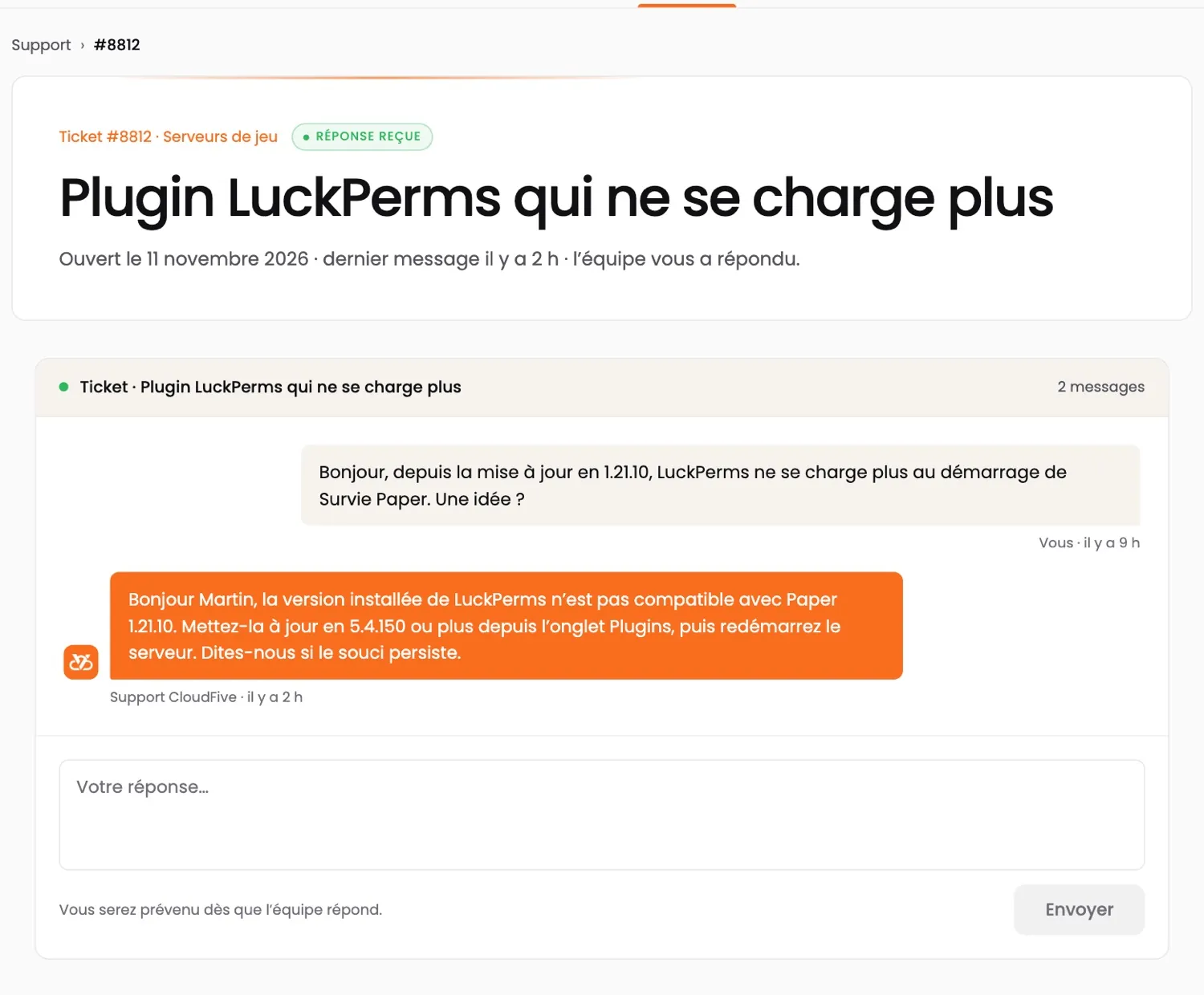
A ticket in the customer area: a customer’s question about a Minecraft plugin, and the CloudFive team’s reply
A real ticket in the customer area, answered by the team (demo account; shown in French).
CUSTOMER AREA · APP

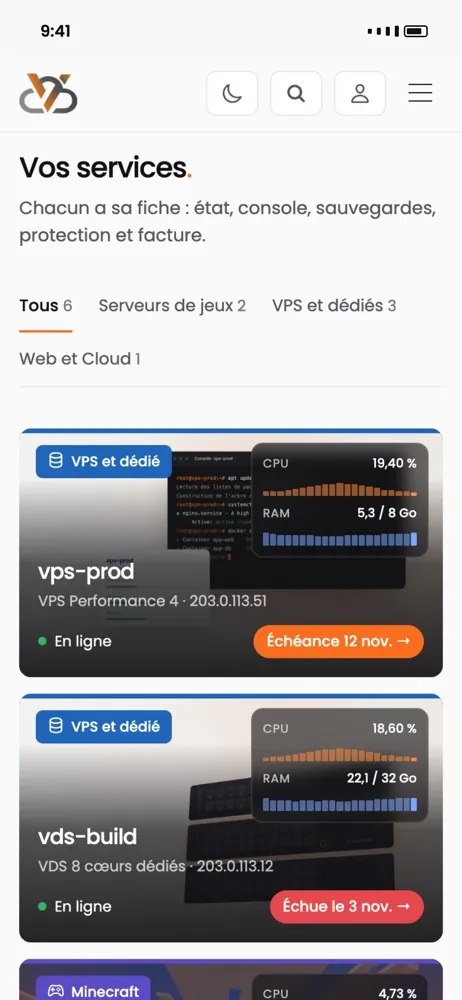
Your servers.
At your fingertips.

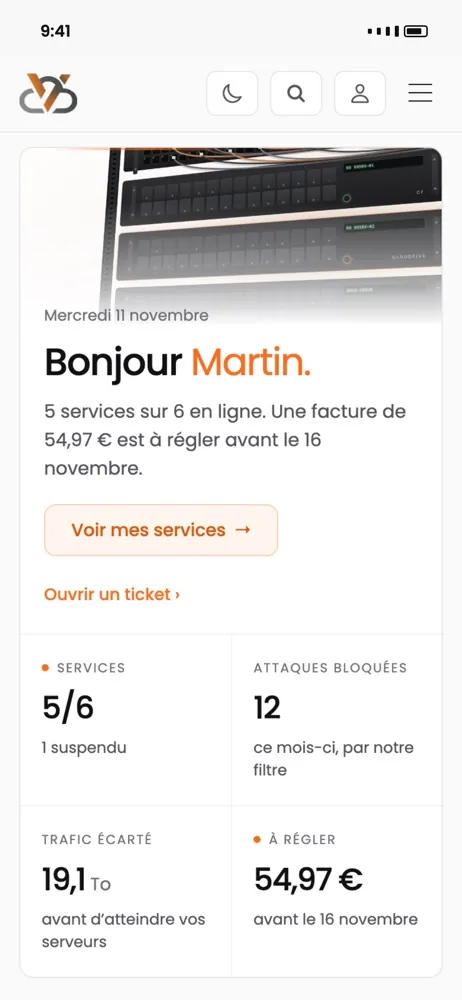
Restart a server, watch its resources live, pay an invoice or open a ticket — and get an alert when something goes wrong.

  • The status of all your services at a glance
  • Blocked attacks, filtered traffic, monthly peak
  • A notification when a server goes down or an invoice is due

App coming soon · in the meantime, everything works in your browser at manager.cloudfive.fr

The CloudFive app: the list of your services, with their status
The CloudFive app: the home screen, your services’ status, blocked attacks and an invoice to pay